
Welcome – Your First Weeks in London
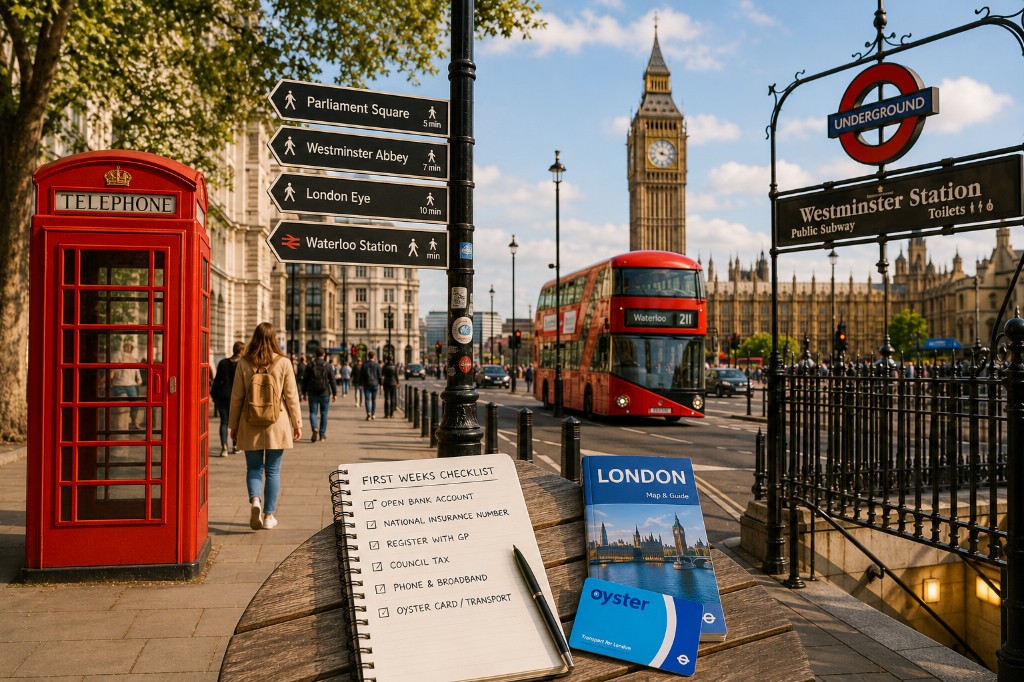
Moving to London is exciting, fast-paced, and sometimes overwhelming. During your first few weeks, you’ll likely be juggling accommodation, paperwork, work or study, banking, healthcare, transport, and everyday essentials. The good news is that London is highly structured, and once you understand how systems work, things become much easier.
This guide is a practical orientation to help you settle in confidently during your first weeks. For immigration, tax or benefits advice, always consult official gov.uk guidance or a qualified adviser.
Getting organised in your first week
Your first priority after securing accommodation should be setting up the basics: banking, phone connectivity, and proof of address. Many UK services rely on address verification, so keeping copies of your tenancy agreement, council tax letter, or employer confirmation is important.
In the UK, proof of address is often required to open accounts, sign contracts, or register with services. If you are staying in temporary accommodation, ask your employer or university if they can provide a confirmation letter while you wait for permanent documents.
Banking and money
Opening a UK current account should be done as soon as possible. A current account allows you to receive salary payments, pay rent, set up direct debits, and manage daily expenses easily.
You typically need:
- Your passport or Biometric Residence Permit (BRP)
- Visa details (if applicable)
- Proof of UK address (tenancy agreement, utility bill, council tax letter)
- Sometimes a UK mobile phone number
Traditional high-street banks have physical branches and may require in-person appointments. App-based banks are increasingly popular and may allow faster setup through identity verification apps. Both are widely accepted for everyday use.
Once your account is open, you will receive a debit card. UK banking relies heavily on contactless payments, and almost all shops accept card transactions. Carrying large amounts of cash is uncommon.
It is advisable to set up online banking immediately. Most services — including rent, utilities, council tax, broadband, and mobile contracts — operate through bank transfers or direct debit systems.
If you plan to send money abroad, compare international transfer fees. Rates can vary significantly between banks and transfer services.
National Insurance (NI)
If you are allowed to work in the UK, you will need a National Insurance (NI) number. This number is used for tax and employment records.
You apply through gov.uk by searching “National Insurance number application.” Depending on your status, you may be invited to attend an identity verification appointment.
Keep all letters from HMRC (His Majesty’s Revenue and Customs). Your NI number is permanent and should be stored safely.
Your employer will request this number for payroll purposes. If you have not received it yet, you can usually begin work and update them once it arrives.
Understanding tax and payslips
The UK operates a Pay As You Earn (PAYE) system. Income tax and National Insurance contributions are automatically deducted from your salary by your employer.
Your payslip will show:
- Gross pay (before deductions)
- Tax deducted
- National Insurance contributions
- Pension contributions (if enrolled)
- Net pay (what you receive)
If you think you are on the wrong tax code, contact HMRC directly via official channels.
GP and NHS registration
The UK’s National Health Service (NHS) provides healthcare. You should register with a General Practitioner (GP) near your home as soon as possible. See our Register with a GP in London guide for a step-by-step walkthrough.
Registration is free. You will need:
- ID (passport)
- Proof of address
You do not need to pay to register with a GP. Once registered, you can book appointments for general health concerns.
For urgent but non-emergency medical advice, call 111. For life-threatening emergencies, call 999. See also our Emergency numbers page.
Dentistry and opticians operate slightly differently and may involve charges unless you qualify for exemptions.
Keep your NHS number safe once issued.
Council tax and local services
If you rent or own property, you may be liable for council tax. This tax funds local services such as waste collection, libraries, and local infrastructure.
Council tax is based on property valuation bands. Your local borough council website explains:
- Band rates
- Student exemptions
- Single-person discounts (usually 25%)
- Payment methods
In shared houses (HMOs), responsibility for council tax depends on the tenancy agreement.
Contact your London borough council for:
- Bin collection schedules
- Recycling rules
- Parking permits
- Local services
- Resident parking registration
Understanding your borough’s website is essential. Each London borough manages its own local services.
Phone, broadband and connectivity
A UK mobile number is essential. SIM-only contracts are flexible and affordable. Compare providers for data coverage in your area.
Broadband setup depends on your accommodation. Some properties already have active connections. If not, you can arrange installation with providers operating in your postcode.
Check:
- Contract length
- Installation fees
- Minimum term
- Cancellation policies
Reliable internet is particularly important if you work remotely.
Public transport basics
London’s public transport system is extensive and efficient. Most residents rely on it daily.
You can use:
- Contactless bank card
- Apple Pay / Google Pay
- Oyster card
There is no need to buy paper tickets for regular travel.
Daily fare caps apply. Once you reach a maximum spending limit within your travel zones, additional eligible journeys that day may not cost extra.
Consider registering your contactless card online to track journey history.
Tube, bus, rail, and Overground networks connect nearly all areas of London. Apps like Citymapper and Google Maps simplify navigation. Read our Transport basics and get around London without a car guides for full detail.
Housing and tenancy essentials
If renting privately, you will typically sign an Assured Shorthold Tenancy (AST). Read your agreement carefully. Our Renting in London guide covers deposits, references and Right to Rent.
Key points include:
- Deposit amount
- Length of tenancy
- Notice period
- Maintenance responsibilities
Your landlord must protect your deposit in a government-approved scheme. You should receive confirmation documentation.
Keep copies of:
- Tenancy agreement
- Deposit protection certificate
- Inventory report
Report maintenance issues in writing. Also read Avoid scams in London rentals before paying large sums to strangers.
Everyday practicalities
Supermarkets
Major supermarkets include Tesco, Sainsbury’s, Asda, Morrisons, and Aldi. Smaller convenience versions operate in central areas.
Payment culture
Contactless card payments dominate. Even small purchases are paid digitally.
Tipping
Tipping is not mandatory but appreciated in restaurants (around 10–12.5%). Some restaurants include service charge automatically.
Opening hours
Shops often close earlier than in some countries. Sunday trading hours may be limited.
Safety and local awareness
London is generally safe, but as in any large city, stay aware of your surroundings.
Keep belongings secure, particularly in busy areas and on public transport.
Save important numbers:
- 999 for emergencies
- 111 for non-urgent medical advice
Building your network
Joining local groups can help you integrate faster:
- Professional networks
- University societies
- Community groups
- Sports clubs
- Language exchanges
Networking is important in London’s competitive environment.
Understanding cultural norms
London is diverse and multicultural. You will encounter people from all backgrounds.
Common cultural traits:
- Politeness and queuing
- Respect for personal space
- Indirect communication style
- Punctuality in professional settings
Apologising frequently is common in British culture.
Financial planning in your first month
London can be expensive. Track your spending carefully in your first weeks. See Cost of living in London 2026 for a practical budget overview.
Major expenses typically include:
- Rent
- Deposit
- Council tax
- Utilities
- Transport
- Food
Budgeting early prevents financial stress later.
Registering with authorities
If you are studying, your university may require address updates.
If working, ensure your employer has your correct NI number and bank details.
If required by visa conditions, update UKVI with address changes via official gov.uk channels.
Waste and recycling
London boroughs have strict recycling rules.
Check:
- Collection days
- Recycling categories
- Food waste separation
- Bulky waste procedures
Incorrect waste disposal can result in fines.
Mental wellbeing
Relocating to a new city can be emotionally challenging. It is normal to experience adjustment stress.
Explore:
- Parks and green spaces
- Local cafés
- Cultural events
- Community activities
Maintaining routine helps with integration.
Transport cards and discounts
Students and young adults may qualify for:
- 16–25 Railcard
- 26–30 Railcard
- Student Oyster discounts
Check eligibility online.
Employment rights
Employees in the UK have:
- Paid holiday entitlement
- Minimum wage protections
- Sick leave policies
- Workplace safety rights
Review your employment contract carefully.
Important official guidance
This page is practical orientation only. For immigration, tax, benefits, or legal matters, always use official gov.uk guidance or seek advice from a qualified adviser.
Avoid relying solely on social media advice for legal or immigration matters.
Final thoughts
Your first weeks in London will feel busy, sometimes confusing, but also full of opportunity. Once your bank account is open, your GP registration completed, your council tax sorted, and your transport system understood, daily life becomes manageable.
London rewards organisation. Keep documents safe, stay informed, and use official resources when needed.
Within a few weeks, the city that once felt overwhelming will start to feel structured — and eventually, like home.