
Transport basics
Oyster, contactless, zones, buses, and planning journeys — caps, tapping rules, Tube, Elizabeth line, night travel and common mistakes.
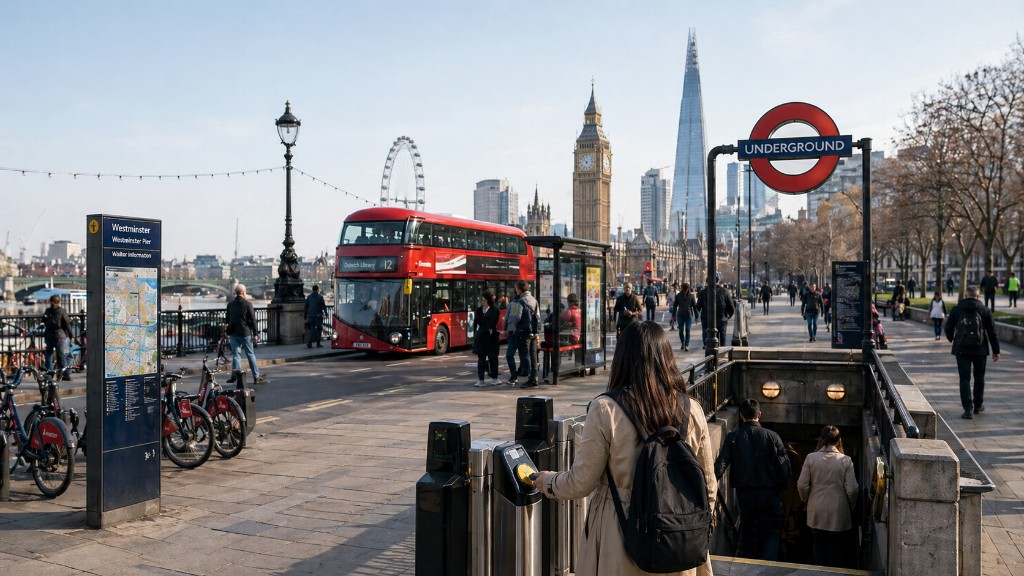
London has one of the largest public transport networks in the world. For newcomers, it can look complicated at first: Tube lines, buses, zones, Oyster cards, contactless payments, daily caps, weekly caps, peak fares, off-peak fares, Elizabeth line, DLR, London Overground, National Rail, night buses, river services and bike hire. Once you understand the basics, however, the system becomes much easier to use.
The most important thing to know is this: in most cases, you do not need to buy paper tickets for everyday travel in London. You can use a contactless bank card, a mobile wallet, or an Oyster card. You tap in and out on rail journeys, and you tap once on buses and trams. The fare is calculated automatically.
This guide explains the basics: how Oyster and contactless work, what London fare zones mean, how buses are priced, when to use Travelcards, how to avoid common payment mistakes, and how to plan journeys around the city.
Oyster and contactless
For most visitors and residents, the easiest way to pay for London transport is with a contactless bank card or mobile wallet such as Apple Pay or Google Pay. You can use contactless on the Tube, buses, trams, DLR, London Overground, Elizabeth line, and many National Rail services within London.
An Oyster card is a reusable smart card issued by Transport for London. You can add pay-as-you-go credit, Travelcards, Bus & Tram Passes or eligible discounts. Oyster is still useful if you prefer not to use your bank card, if you need certain concessions, or if you use Travelcards.
For ordinary adult travel, contactless is usually the simplest option. You do not need to top it up, and the system automatically calculates your daily and weekly caps when you use the same card or device.
The key rule is:
Always use the same card or device for every journey.
If you tap in with your physical bank card and tap out with your phone, even if they are linked to the same bank account, the system may treat them as different payment methods. That can cause incomplete journeys and higher charges.
Use one payment method consistently for the whole day or week.
How tapping works
On rail services, including the Tube, DLR, London Overground, Elizabeth line and most National Rail journeys in London, you usually need to:
- Tap in at the start.
- Tap out at the end.
You do this on yellow card readers or ticket gates.
If you forget to tap out, the system may not know where your journey ended and may charge a maximum fare. This can be expensive, especially on longer rail routes.
On buses and trams, the rule is different:
- Tap in once when boarding.
- Do not tap out.
There are no bus zones. The bus fare is flat across London, regardless of distance. You simply touch your card or Oyster on the yellow reader when you get on the bus.
Daily and weekly caps
One of the most useful parts of London transport payment is fare capping. This means that after you spend a certain amount in a day or week, additional eligible journeys may not cost extra within the zones and modes covered. See TfL fares for current cap levels.
Daily capping is useful for visitors and residents who make several trips in one day. Weekly capping is useful for people who travel regularly but do not want to buy a separate Travelcard.
The weekly cap for contactless usually runs from Monday to Sunday. This matters if you arrive midweek. If you arrive on a Friday and travel heavily over the weekend, you may not benefit from a full weekly cap in the same way someone travelling Monday to Sunday would.
Oyster also has daily capping, but contactless is often more convenient for weekly capping. If you are commuting every weekday, contactless can work well. If you need a Travelcard loaded for a specific period, Oyster may still be useful.
Oyster card or contactless: which is better?
For most adults, use contactless.
Contactless is best if
- You have a UK or international contactless card.
- You use Apple Pay or Google Pay.
- You do not need a special discount.
- You want automatic daily and weekly capping.
- You do not want to top up a card.
Oyster is useful if
- You prefer a separate travel card.
- You want to add a Travelcard.
- You use certain railcards or concessions.
- You do not want to use your bank card.
- You are managing travel for someone else.
For tourists, contactless is usually easier if your bank card works in the UK. However, check whether your bank charges foreign transaction fees. If your card has high fees, Oyster may be more predictable.
Understanding London zones
London’s rail fares are based partly on fare zones. Central London is mostly Zone 1. The city then expands outward through Zones 2, 3, 4, 5, 6 and beyond in some cases.
Most tourist attractions and central business areas are in Zones 1 and 2. Many residential areas are in Zones 2 to 6. Airports can be outside normal central zones or have special fares depending on route.
In general:
- Zone 1 = Central London
- Zones 2–3 = inner and middle London
- Zones 4–6 = outer London
The more zones you travel through, the higher your rail fare may be. Peak and off-peak times can also affect the fare on Tube and rail journeys.
This is why living further out can reduce rent but increase transport costs and journey time. For commuters, it is important to calculate both housing and transport together.
Peak and off-peak fares
Rail fares can vary depending on the time of travel. Peak fares are usually charged during weekday rush-hour periods. Off-peak fares are usually cheaper and apply outside the busiest times.
Buses and trams have flat fares, so peak and off-peak rules do not work the same way for them.
For newcomers, the easiest approach is to use TfL’s fare tools or the TfL app to check costs. If you commute daily during peak hours, transport can become a significant monthly expense. If you work hybrid or travel off-peak, contactless pay-as-you-go may be cheaper than buying a monthly pass.
Tube basics
The London Underground, known as the Tube, is the most famous part of the network. It is organised by lines, each with a name and colour. Examples include:
- Central line
- Northern line
- Victoria line
- Jubilee line
- Piccadilly line
- District line
- Circle line
- Elizabeth line is not Tube, but appears on TfL maps
The Tube is usually fast and frequent, especially in central areas. It is often the easiest way to travel longer distances across London.
However, not every part of London has a Tube station. South East London, for example, relies more on National Rail, London Overground, buses and DLR. Do not judge an area only by whether it has a Tube station. Some non-Tube areas are still very well connected.
When using the Tube, always check the direction before boarding. Lines often split into branches, especially the Northern, District and Metropolitan lines. Make sure the train is going to the correct destination.
London Overground, DLR and Elizabeth line
London transport is not just the Tube.
The London Overground connects many parts of outer and inner London, especially orbital routes that do not go directly through the West End. It is very useful in areas such as Hackney, Dalston, Peckham, Canada Water, Clapham Junction, Willesden Junction and Stratford.
The DLR, or Docklands Light Railway, is especially useful in East and South East London. It serves Canary Wharf, Greenwich, Lewisham, Stratford, Bank, Tower Gateway, London City Airport and Docklands areas.
The Elizabeth line is one of London’s most important newer rail services. It connects Heathrow and West London with Central London, the City, Canary Wharf and East London. It is often faster and more spacious than older Tube lines. See our Elizabeth line complete guide for stations, interchanges and Heathrow.
For many journeys, the best route may involve a combination of Tube, Overground, DLR, Elizabeth line, National Rail and bus.
Buses
London buses are one of the best-value ways to travel around the city. They are slower than the Tube for long distances but extremely useful for short and medium trips. They also let you see the city above ground.
On buses:
- Tap in once when boarding.
- Do not tap out.
- The fare is flat.
London has a Hopper fare, which allows additional bus or tram journeys within a set time window after the first tap, as long as you use the same card or device. This is very useful for short journeys with changes.
Buses are also important late at night. Many routes continue after the Tube closes, and night buses cover large parts of London. Some Tube lines run Night Tube services on certain nights, but buses remain essential for late travel.
For new residents, learning your local bus routes is just as important as learning the nearest Tube station.
Night travel
London does not shut down completely at night, but transport changes.
Some Tube lines have Night Tube services on Friday and Saturday nights, depending on line and service status. Many buses run late or operate as night buses. Ride-hailing, black cabs and minicabs are also available, but they cost more than public transport.
If you are travelling late:
- Check the route before leaving.
- Use well-lit stops and stations.
- Keep your phone charged.
- Use licensed taxis or reputable private hire services.
- Avoid unofficial drivers.
Night buses can be very useful but slower than daytime journeys. Always check the route direction carefully.
Walking and cycling
Walking is often underrated in London. Many central stations are closer than they look on the Tube map. For example, walking between some central areas can be faster than changing lines underground.
Cycling can also be practical, especially for short trips and commutes in flatter areas. Santander Cycles are London’s public bike hire system. They can be useful for short journeys in central areas and parks, though availability varies by location.
Before cycling, check the route. Some roads are busy and intimidating, while others have cycle lanes or quieter backstreet routes. London is improving cycling infrastructure, but comfort levels vary.
For short central journeys, compare walking, bus and Tube. The fastest option is not always underground.
Planning journeys
Use TfL Journey Planner, the TfL Go app, Citymapper, Google Maps or Apple Maps to plan routes. TfL tools are especially useful for official live status, disruptions, step-free access and planned engineering works.
Before travelling, check:
- Journey time
- Number of changes
- Walking distance
- Step-free access
- Service disruptions
- Weekend closures
- Last train times
- Fare zones
Weekend engineering works are common. A route that works perfectly on a weekday may change on Saturday or Sunday. Always check before important journeys, airport trips or events.
For accessibility, use TfL’s step-free route options. Some stations have lifts, some have escalators, and some have stairs only. With luggage, a baby stroller or mobility needs, this can make a big difference.
Common mistakes to avoid
The most common mistake is mixing payment methods. Do not tap in with a bank card and tap out with a phone. Use the same method.
The second mistake is forgetting to tap out on rail journeys. This can create a maximum fare.
The third mistake is tapping out on buses. You do not need to tap out on London buses.
The fourth mistake is assuming the Tube is always fastest. Sometimes a bus, walk or Elizabeth line route is better.
The fifth mistake is ignoring zones when choosing where to live. Cheaper rent can be partly offset by higher transport costs.
The sixth mistake is not checking weekend closures. London transport often has planned works.
The seventh mistake is buying a pass before knowing your routine. If you work hybrid, pay-as-you-go may be cheaper than a monthly Travelcard.
Practical advice for newcomers
In your first week in London, use contactless if possible. Learn your nearest Tube, bus, Overground or rail stations. Save your home address in your maps app. Check your route before leaving, especially during peak times.
For commuting, test two or three routes. The fastest route on paper may be crowded or stressful. A slightly slower route with fewer changes may be better for daily life.
If you are choosing a place to live, check transport at the exact times you will travel. A station may look close on a map, but the walk, crowding or service frequency can change your experience.
Also check night transport if you work late or go out often. A good daytime commute is not the whole picture.
Final summary
London transport becomes much easier once you understand the basics. Use contactless or Oyster. Tap in and out on rail. Tap only once on buses. Use the same card or device every time. Understand zones before planning regular journeys. Check peak and off-peak fares if you commute. Learn local bus routes as well as Tube routes. Use TfL tools for live updates and step-free access.
For most adults, contactless payment is the simplest option. Oyster remains useful for Travelcards, concessions and people who prefer a separate travel card. Buses are excellent value, the Tube is fast, the Elizabeth line is useful for longer cross-city trips, and walking or cycling can be best for short journeys.
The smartest approach is flexible. London has many transport modes, and the best journey is not always the one that looks obvious on the Tube map. Use the network well, and the city becomes much easier to understand.