
Emergency numbers
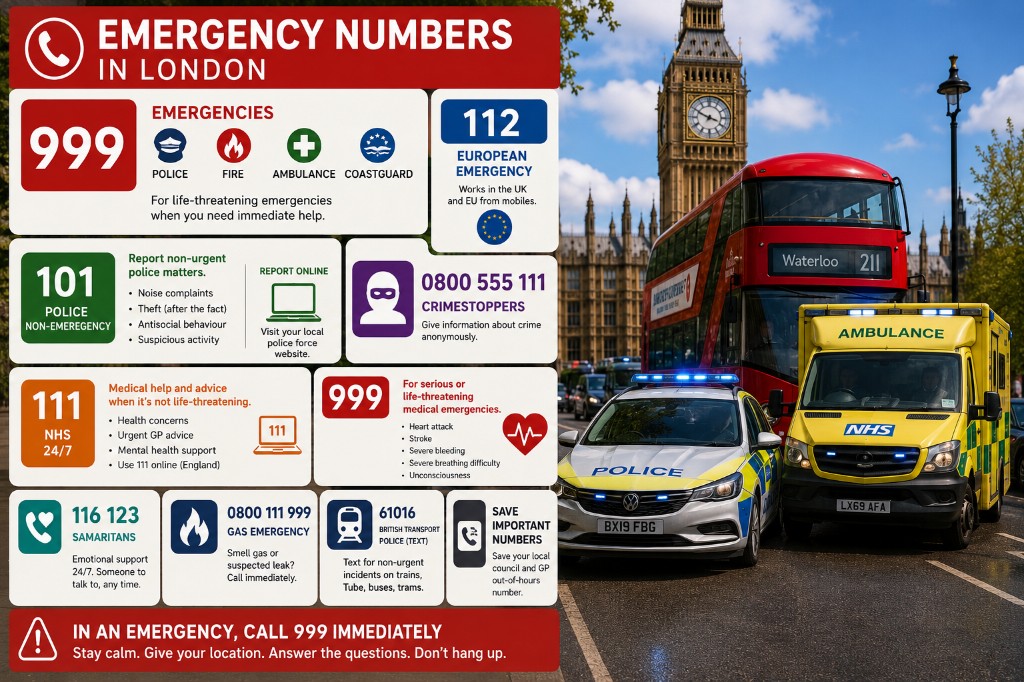
Knowing who to call in an emergency is one of the most important parts of settling into life in London. Whether you are new to the UK or simply unfamiliar with the British system, understanding which number to use — and when — can make a critical difference.
This guide explains the main emergency and support numbers in London and the wider UK, when to use them, and what to expect when you call. For first-week setup including GP registration, see Welcome – Your First Weeks in London.
Life-threatening emergencies
999 — Police, Fire, Ambulance, Coastguard
Call 999 when you need an immediate emergency response. This number connects you directly to emergency services.
Use 999 if:
- Someone’s life is in danger
- A serious crime is happening right now
- There is a fire
- Someone is unconscious or not breathing
- Severe bleeding cannot be controlled
- There is suspected heart attack or stroke
- There is severe breathing difficulty
- There has been a serious accident
When you call 999, the operator will ask:
- Which service you require (police, fire, ambulance, coastguard)
- Your location
- What has happened
- Whether anyone is injured
Stay calm and answer clearly. If you do not know your exact address, give nearby landmarks, road names, or postcode if possible.
Do not hang up until instructed to do so.
112 — Alternative emergency number
You can also dial 112, which works across the UK and EU, especially from mobile phones. It routes to the same emergency services as 999.
This number is useful if you are accustomed to European emergency numbers.
Text relay and accessibility
If you are deaf, hard of hearing, or speech-impaired, you can use the 999 text relay service, but you must register in advance via gov.uk (Relay UK).
This ensures that emergency services can communicate with you effectively.
Police and crime (non-emergency)
101 — Police non-urgent matters
Call 101 for non-emergency police issues.
Use 101 for:
- Noise complaints
- Antisocial behaviour (when not urgent)
- Theft after the incident has occurred
- Minor vandalism
- Lost property
- Reporting suspicious activity
Do not call 999 for non-urgent matters. Using 101 keeps emergency lines free.
You can also report many issues online via your local police force website.
0800 555 111 — Crimestoppers (anonymous)
Crimestoppers allows you to give information about crime anonymously.
Use this number if:
- You want to report criminal activity
- You do not want to give your name
- You have information about ongoing crime
Your identity will not be recorded.
Health services
111 — NHS 24/7 non-urgent medical advice
Call 111 when you need medical advice but it is not life-threatening.
Examples:
- Fever or persistent symptoms
- Minor injuries
- Suspected infection
- Medication questions
- Urgent GP appointments outside normal hours
You can also use 111 online in England for symptom checking.
NHS 111 can:
- Arrange urgent GP appointments
- Direct you to urgent care centres
- Send an ambulance if necessary
- Offer clinical advice
Call 999 instead if symptoms are severe or life-threatening. See Register with a GP in London for NHS registration.
When to call 999 for health emergencies
Always call 999 immediately for:
- Suspected heart attack (chest pain, shortness of breath)
- Stroke symptoms (Face drooping, Arm weakness, Speech difficulty)
- Severe allergic reaction
- Unconsciousness
- Severe bleeding
- Major trauma
Act quickly — emergency operators will guide you step-by-step.
Mental health and emotional support
116 123 — Samaritans (24/7 emotional support)
Samaritans provides confidential emotional support at any time.
Call 116 123 if:
- You are feeling overwhelmed
- You are experiencing distress
- You need someone to talk to
- You are struggling emotionally
The service is free and available 24/7.
You do not need to be in immediate crisis to call.
Gas and utility emergencies
0800 111 999 — National Gas Emergency
Call immediately if you:
- Smell gas
- Suspect a gas leak
- Hear hissing near gas pipes
If you smell gas:
- Open windows
- Do not use electrical switches
- Do not light matches
- Leave the property if necessary
Gas leaks can be life-threatening. Act immediately.
Transport incidents
61016 — British Transport Police (text, non-urgent)
Text 61016 to report non-urgent incidents on:
- Trains
- Tube
- Buses
- Tram networks
Use for:
- Suspicious behaviour
- Harassment
- Minor disorder
For immediate danger on public transport, call 999. See our Transport basics guide for everyday travel.
Local council and GP out-of-hours
Once registered with a GP, save their out-of-hours number in your phone.
Also store:
- Your local borough council contact number
- Your building management or landlord contact
- Emergency maintenance contacts
Being prepared reduces panic in urgent situations.
What happens when you call 999?
When you dial 999:
- The operator answers.
- You state which service you need.
- You are transferred to that service.
- You answer location and situation questions.
- Help is dispatched.
Remain calm. Operators are trained to extract essential information quickly.
If English is not your first language
Emergency services in London can access interpreters. If needed:
- Say your language clearly.
- Stay on the line.
- An interpreter will join the call.
Do not hang up.
Children and emergency education
If you have children, teach them:
- How to dial 999
- When to use it
- Their home address
This knowledge can save lives.
Emergency apps and preparedness
Consider:
- NHS App (for medical records)
- Local police apps
- Journey planning apps for evacuation routes
Keep your phone charged and carry a power bank.
Common mistakes to avoid
- Calling 999 for minor illnesses
- Ignoring gas smells
- Delaying emergency calls out of uncertainty
- Assuming someone else has already called
If in doubt and someone is in danger, call 999.
Emergency situations at work
Know:
- Your workplace evacuation procedures
- Fire assembly point
- First aid contacts
Most workplaces in London have trained first aiders.
Extreme weather and city alerts
London rarely experiences extreme weather, but during:
- Severe storms
- Heatwaves
- Flood alerts
Follow official advice from the Met Office and your local council.
Keeping personal emergency information
Store in your phone:
- ICE (In Case of Emergency) contact
- Medical conditions
- Allergies
- Blood type (if known)
Many smartphones allow emergency medical ID settings accessible without unlocking.
Staying safe in public spaces
London is generally safe, but:
- Stay aware at night
- Avoid poorly lit areas alone
- Use licensed taxis
- Keep valuables secure
Trust your instincts.
What if you call by mistake?
If you dial 999 accidentally:
- Do not hang up.
- Inform the operator it was a mistake.
Silent calls may trigger emergency dispatch.
Summary of key numbers
| Number | Service |
|---|---|
| 999 | Immediate emergency (police, fire, ambulance, coastguard) |
| 112 | Alternative emergency number (UK and EU mobiles) |
| 101 | Police non-emergency |
| 111 | NHS advice (non-life-threatening) |
| 116 123 | Samaritans (emotional support) |
| 0800 111 999 | Gas emergency |
| 61016 | British Transport Police (text) |
Save these in your phone during your first week in London.
Final advice
Emergencies are rare, but preparation matters.
- Keep essential numbers accessible.
- Know your postcode and address.
- Register with a GP.
- Stay informed through official channels.
This page is practical orientation only. For official guidance, always consult gov.uk or appropriate authorities.
London is a safe and well-organised city — knowing the right number to call simply ensures you are prepared if you ever need help. More resources are available on our Emergency & public information hub.